Every Watch Steve McQueen Wore On Screen - Intro
Steve McQueen is remembered for one watch above all others, and it's the one he wore for a single film and never touched again once the cameras stopped rolling. Across four films made between 1968 and 1980, McQueen wore an American field watch, a French dress watch misidentified in nearly every article written about it, his own personal alarm complication, and a chronograph that started as a commercial flop and ended up the most valuable in its brand's history. This guide runs through all seven, in the order he wore them.
Benrus 3061
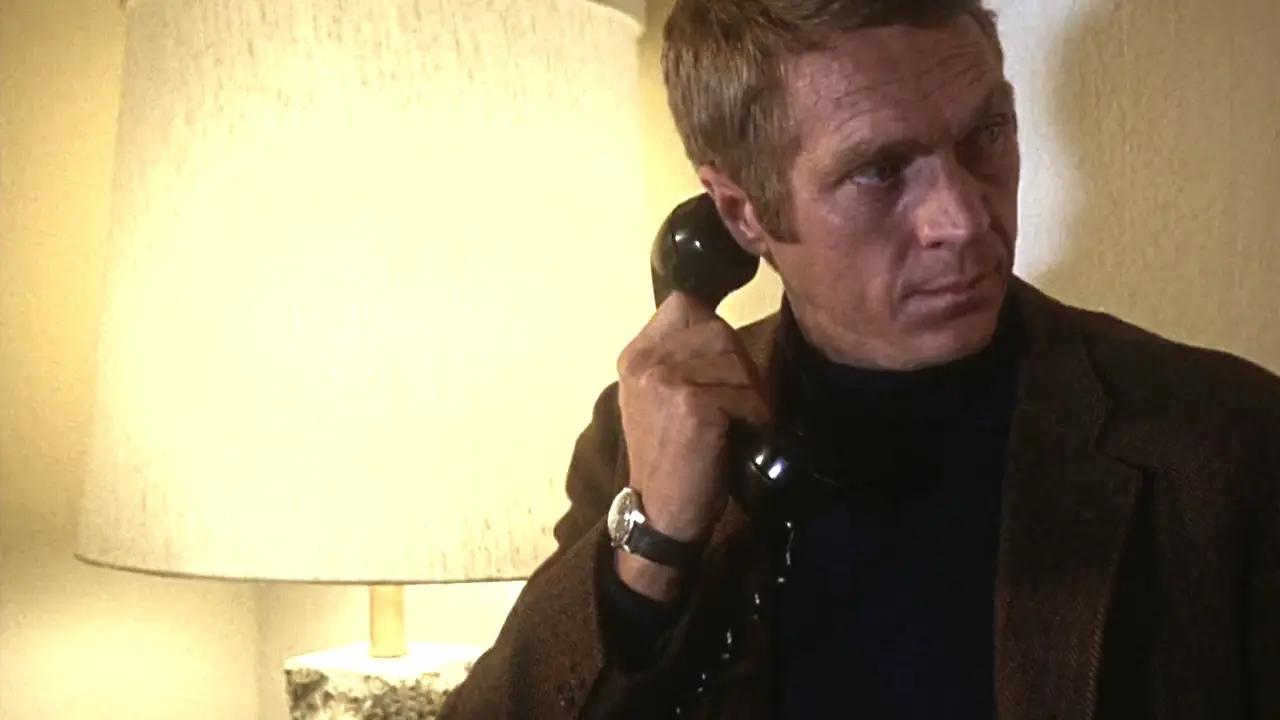
Frank Bullitt's watch tells you who he is before he says a word. The Benrus 3061 retailed for around $50 in 1968, a fraction of the Rolex Submariner's $150 or the Heuer Carrera's $100 that same year, on a detective who lives in a plain apartment and drives an unmarked Charger by assignment. It runs on a Benrus-signed ETA 2372 manual-wind movement inside a 35mm stainless steel case with roughly 36 hours of power reserve, a plain acrylic crystal, and minimal water resistance, built as a field watch rather than a tool watch. Benrus made its name on U.S. military supply contracts through the Second World War and Korea, then lost ground through the 1960s as Swiss and Japanese competition redefined the industry it used to lead. Clean examples today run $200 to $500, and they aren't hard to find, which is fitting: it's a watch that was never meant to be rare, on a character whose whole appeal is that he doesn't need to prove anything.
We may earn a commission on purchases.
Cartier Tank Allongée 21612
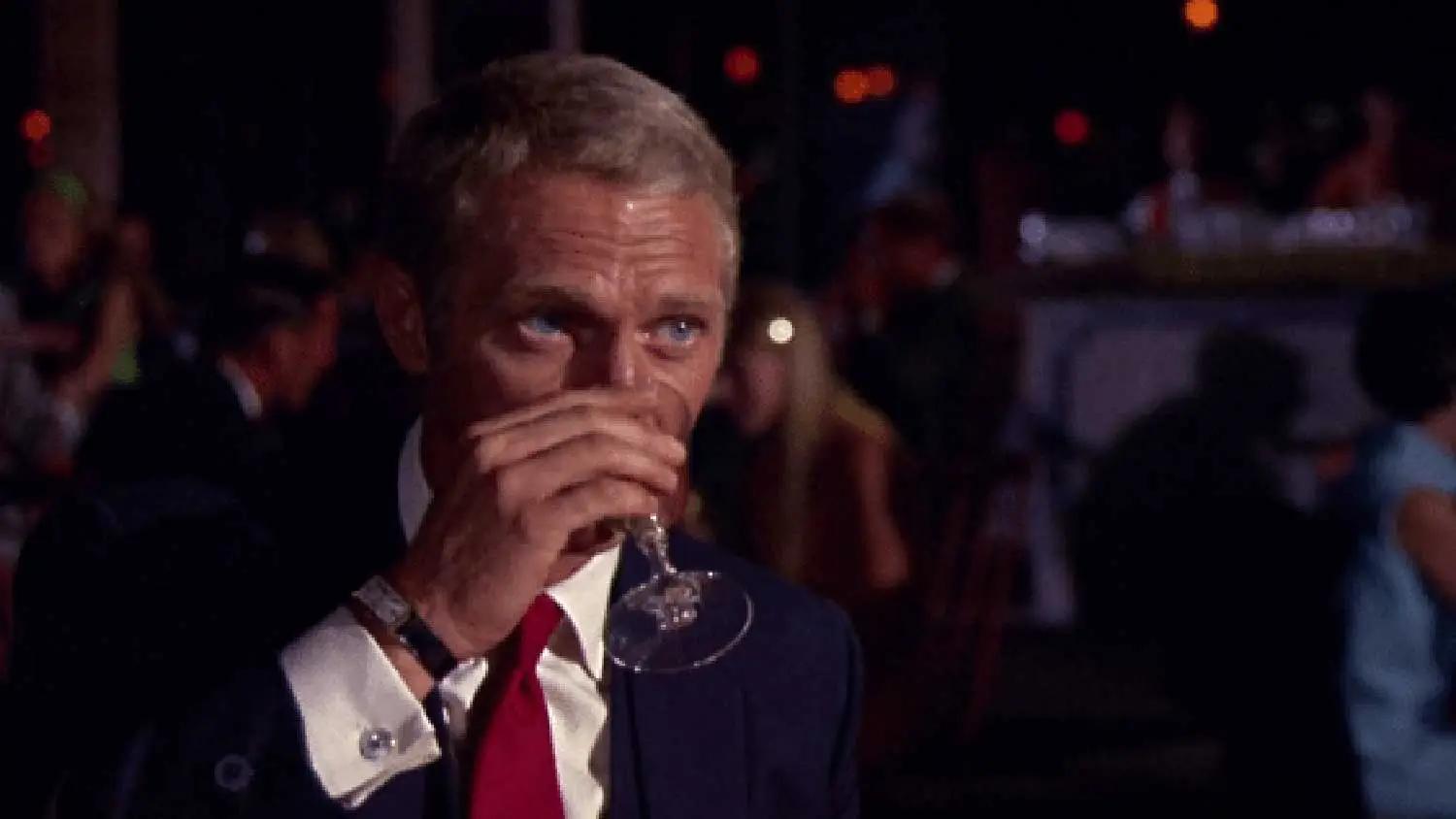
Thomas Crown wears three watches across the film, and the one in the dinner scene with Vicki Anderson has been misidentified in nearly every article written about the movie. It's a Tank Allongée, retailed exclusively through Cartier New York for a short window in the 1960s and 70s, not the Tank Cintrée it's almost always called. The Cartier Tank line traces to 1919, when Charles Cartier based the case shape on the overhead silhouette of a WWI tank. The Allongée stretches and arches that case dramatically, engineered by Edmond Jaeger, friend of Louis Cartier and founder of Jaeger-LeCoultre, whose exceptionally thin manual-wind caliber (the 21612 runs an ETA 2541) sits behind the curve without mechanical compromise. The case is 18kt gold plate over base metal, roughly 19mm by 7mm thick, on an acrylic crystal. A Parisian design sold only through a New York boutique, on the wrist of a Boston billionaire operating in New York: the placement lines up exactly, even where the identification usually doesn't. Clean examples on the secondary market start above $5,000.
Jaeger-LeCoultre Memovox E855
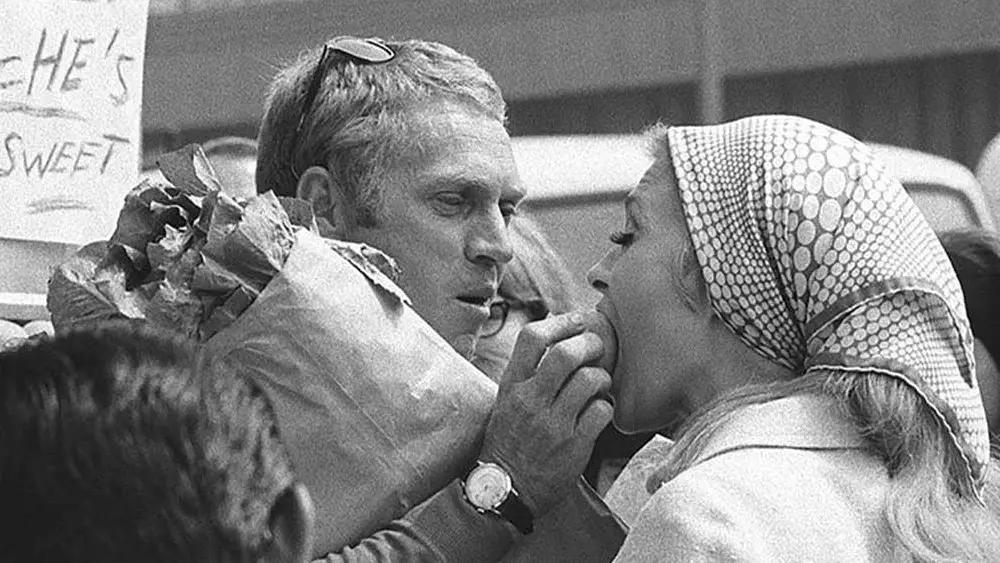
Of Crown's three watches, the Memovox is the one that was actually McQueen's own, worn to set rather than chosen for him, and it's on camera during the film's most relaxed scene: an afternoon with Anderson away from the boardroom and the vault. JLC launched the Memovox in 1951, two years after Vulcain built the first wristwatch alarm, in a two-crown gold case around 33mm, one crown for time, one for setting the rotating alarm bezel. The manual-wind movement carries two fully independent mainspring barrels, one dedicated to the alarm and one to timekeeping, so setting off the chime doesn't cost you power reserve on the watch itself. Clean gold E855s today trade for roughly $2,000 to $6,000 depending on condition and completeness. Crown selects the least ostentatious watch of the three for the one unguarded moment in the film. McQueen had already made that choice for himself before the script gave him a scene to make it in.
We may earn a commission on purchases.
Patek Philippe Pocket watch
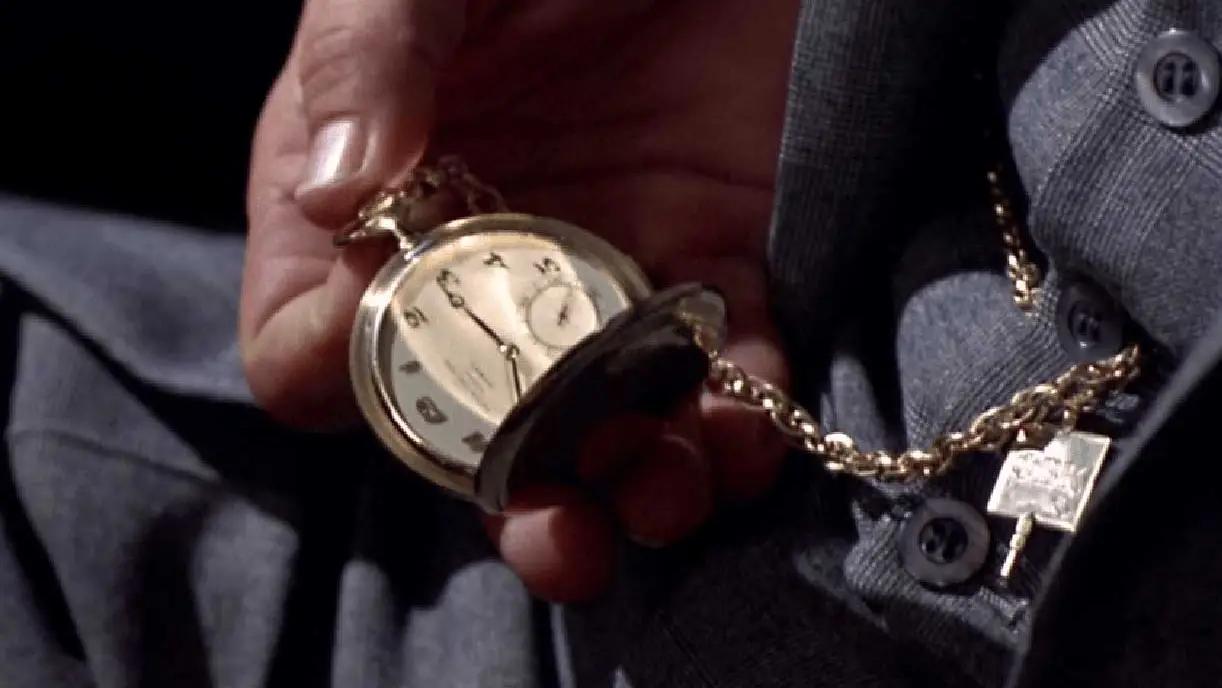
The first thing Thomas Crown does on screen is pull out a pocket watch, not a wristwatch, mid-meeting: a gold full hunter with a hinged case lid, subsidiary seconds, Breguet hands, and Arabic numerals, hung double-Albert style with a fob drop and winding key McQueen turns over in his fingers as a quiet fidget object. The dial appears double signed, carrying both Patek Philippe's name and a retailer's, standard practice for the American market since Patek sold through authorized jewelers rather than its own boutiques. Tiffany & Co. was Patek's main US retailer at the time, making it the likely candidate, though footage quality has never confirmed it, and no exact reference number has been identified. The brand itself isn't in question, this is a real Patek, a product placement rather than McQueen's own watch like the Memovox later in the film. Full hunters of this type ran in 18K gold with manual-wind movements and case diameters in the high 40mm range.
Heuer Monaco 1133B
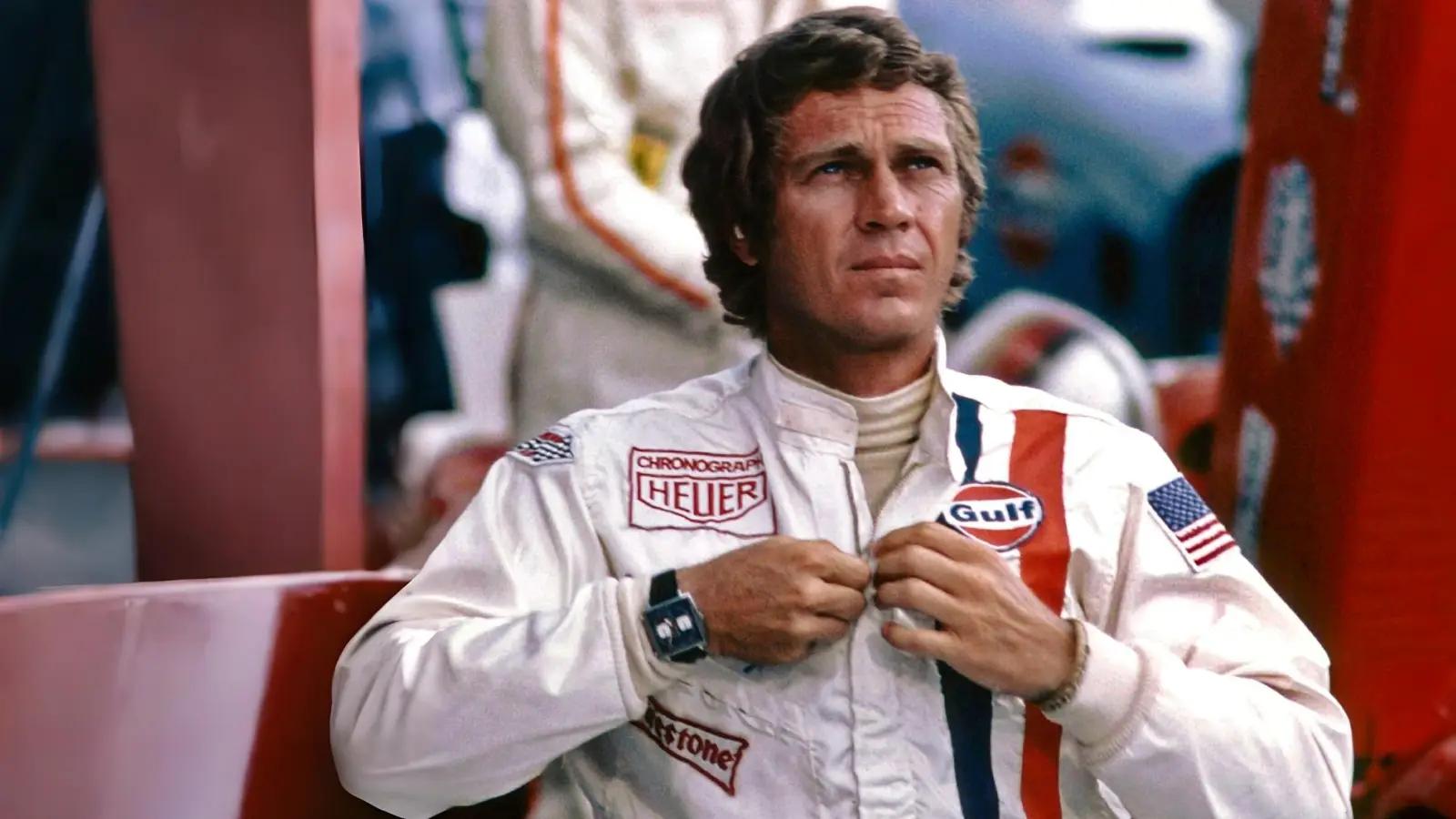
The most famous watch of his career almost went to Omega. Property master Don Nunley laid a table of chronographs from five brands in front of McQueen, who reached first for a Speedmaster, until Nunley pointed out that the racing suit already carried a Heuer patch, worn in tribute to Jo Siffert, the Swiss driver coaching McQueen through the film's racing sequences. An Omega under a Heuer logo made no sense on camera, so McQueen switched to the blue-dialed Monaco, a watch he'd never heard of before that morning. Heuer shipped six examples to the set, driven across the French border by Heuer employee Gerd-Rüdiger Lang, undeclared on Jack Heuer's own instruction; Lang was stopped and fined at customs and delivered the watches anyway. One of the six went missing during filming and has never surfaced. The reference 1133b was, at the time, the world's first waterproof square automatic chronograph: an EPSA case roughly 46mm by 40mm, crown unconventionally mounted at 9 o'clock because the automatic Caliber 11 movement's crown-and-pusher assembly sat on the left side of the case, bi-compax subdials on blue.
McQueen wore his assigned Monaco constantly on set and never touched one again once filming wrapped; the two he kept for himself went to his mechanic Haig Altounian and his friend Bill Maher, both engraved on the caseback. Three of the six have since sold at auction with documented history: Altounian's for $2,208,000 at Phillips in 2020, still the Heuer auction record; a second, worn for decades by Le Mans mechanic Bevan Weston, for $1,440,000 at Sotheby's in 2024; and a third, kept by Nunley himself with roughly 500 pages of his own production archive attached, for just $640,000 at Sotheby's in 2026, the best-documented of the three and, oddly, the cheapest. What launched as a commercial flop in 1969 is now the single most valuable Heuer reference ever sold: a watch that wasn't his but ended up carrying his name more permanently than anything he actually owned.
We may earn a commission on purchases.
Rolex Submariner 5512
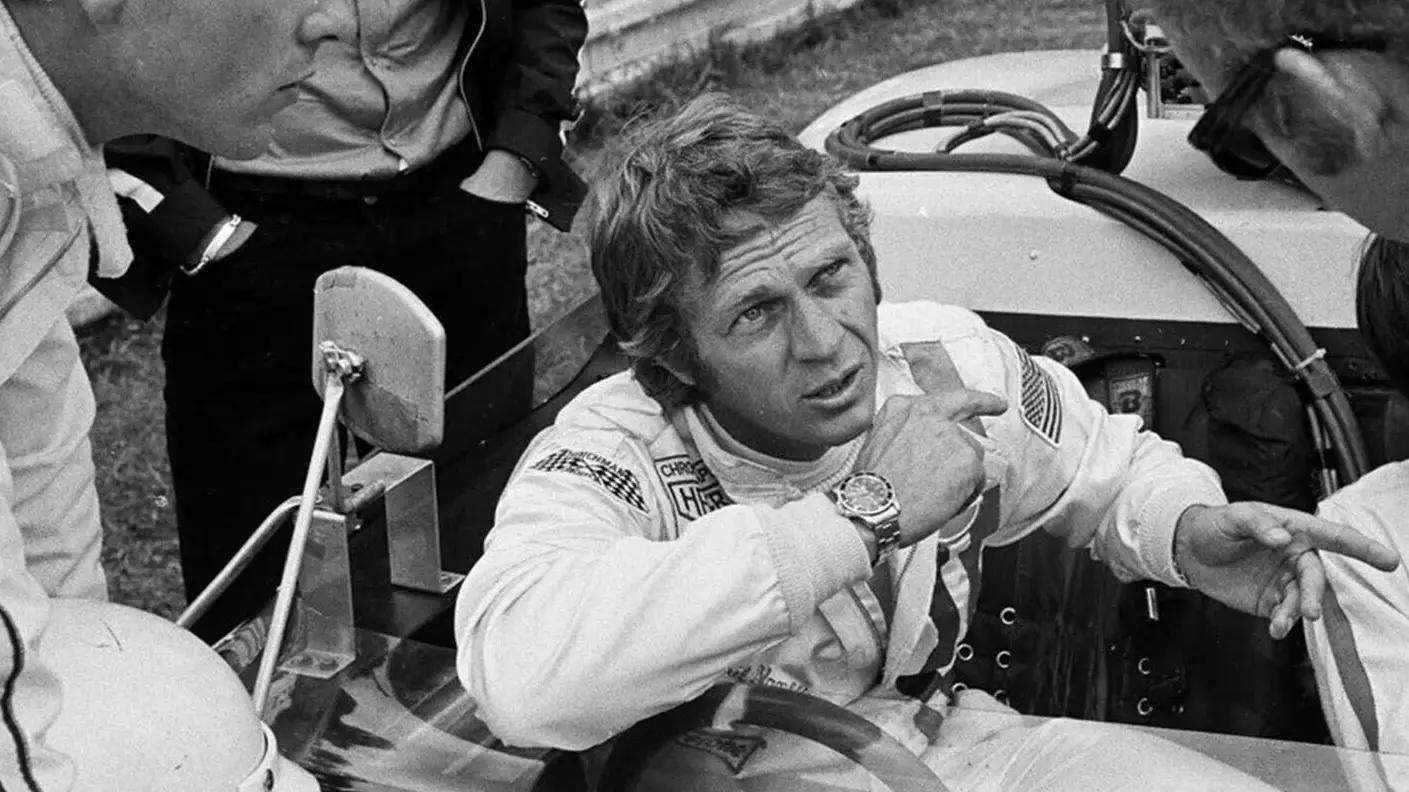
This one never actually appears in the finished film. Every production photo from the Le Mans set shows the same watch on McQueen's right wrist, the way he wore every watch he owned, and it's a 5512: 40mm stainless steel Oyster case, automatic Caliber 1570, four lines of dial text confirming COSC chronometer certification, acrylic crystal, 200m water resistance. He'd been photographed in it a few months earlier at the 12 Hours of Sebring, where he and co-driver Peter Revson finished second in the three-liter class in a Porsche 908/02, McQueen driving the entire race with a cast on his left foot from a motorcycle crash two weeks prior. On the Le Mans set that summer, the Monaco went on the instant the cameras rolled and came off the moment they stopped, at which point the Submariner reappeared: by the pit wall, on a motorbike circling the track, sitting with his son Chad between setups. It's the watch that was actually his, one prop table over from the one that made him famous, and it sold at Antiquorum in 2009 for $234,000.
Rolex Submariner 5512
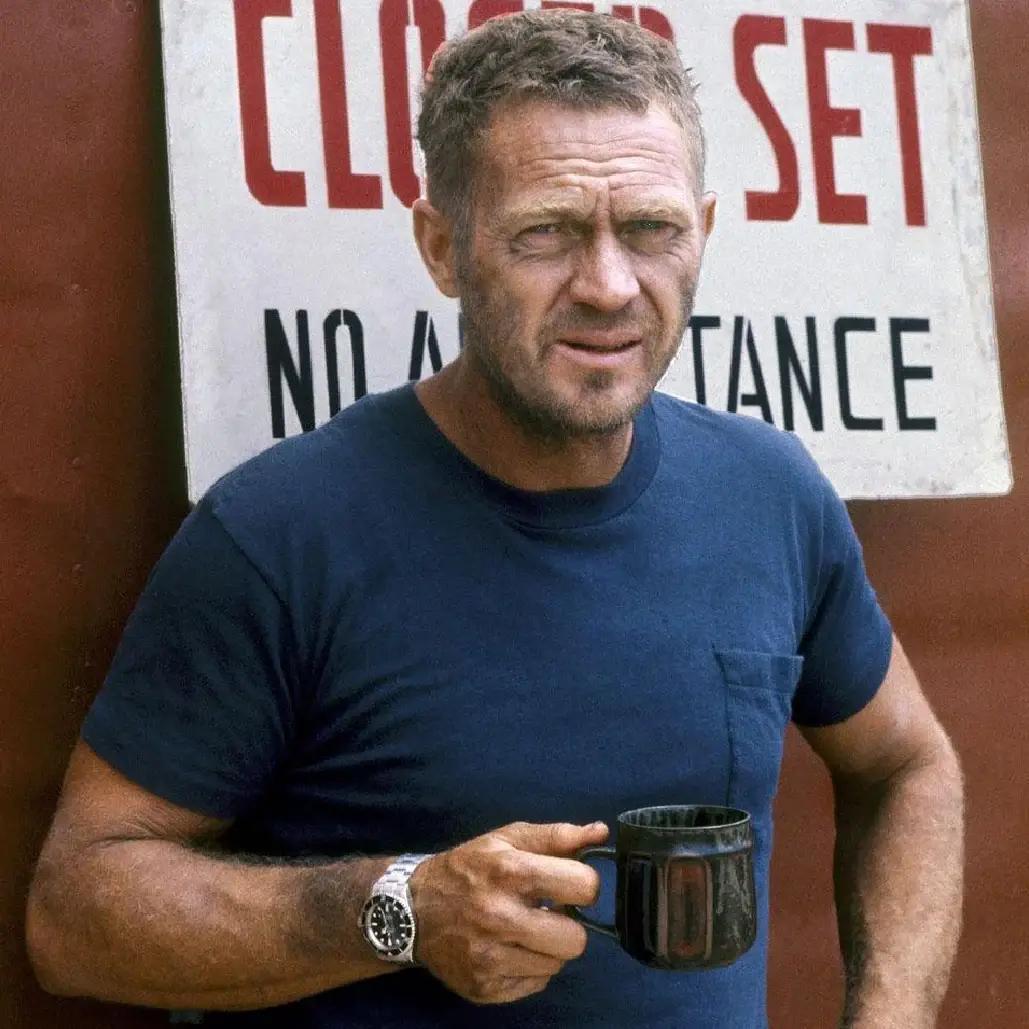
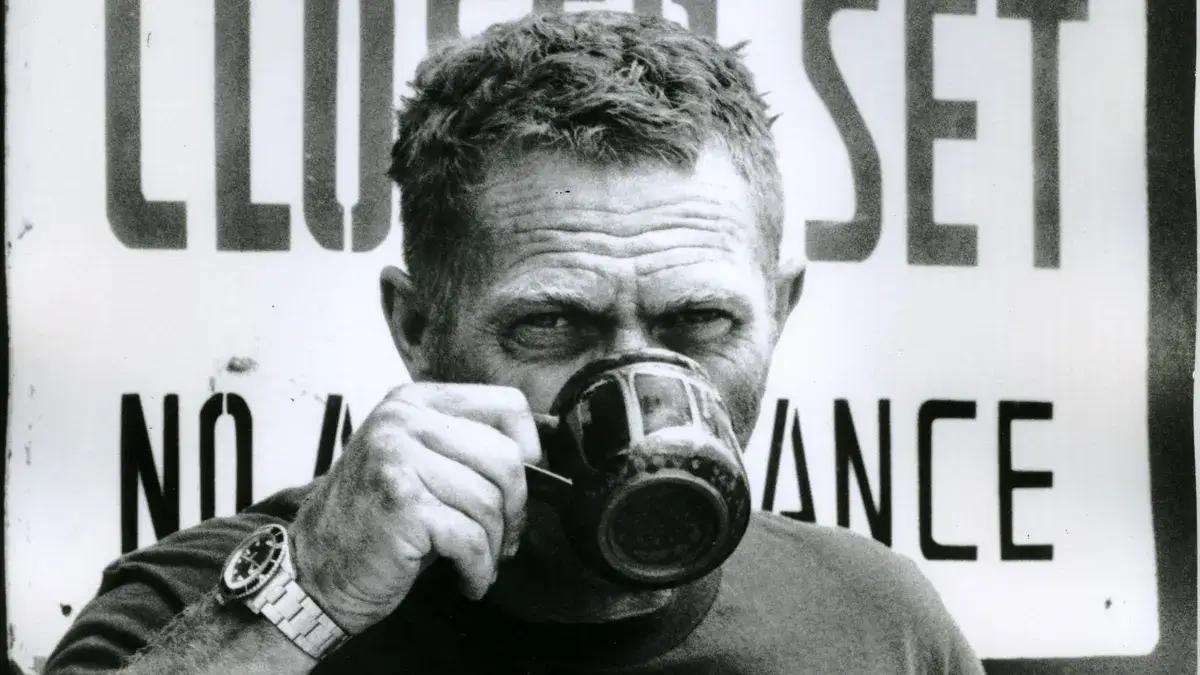
The photo is one of the most reproduced images of Steve McQueen ever taken: leaning against a trailer, an enamel mug in hand, a "Closed Set" sign behind him, stubble, tired eyes, off duty between takes. On his right wrist, the same steel Submariner. Papillon casts McQueen as Henri Charrière, a convict shipped to a French penal colony in Guiana after being framed for murder, adapted from Charrière's own bestselling memoir, and a prisoner stripped of his name owns nothing, least of all a Rolex, so no watch survives onto the character. The photo, taken by Ron Galella during a break in filming, has circulated for decades as shorthand for McQueen off camera, unglamorous and unbothered, wearing the same 5512 documented at Sebring and on the Le Mans set three years earlier. At least one source has read this specific image as the visually similar 5513 instead, going by dial line count, but the two references share an identical case and are close to impossible to distinguish at this resolution and angle; set against the rest of his documented wrist history across the decade, this reads as the same watch rather than a second one. Papillon gives McQueen a character with nothing left to own. The photograph everyone remembers from the shoot shows him with exactly one thing that was entirely his.
Rolex Submariner 5512
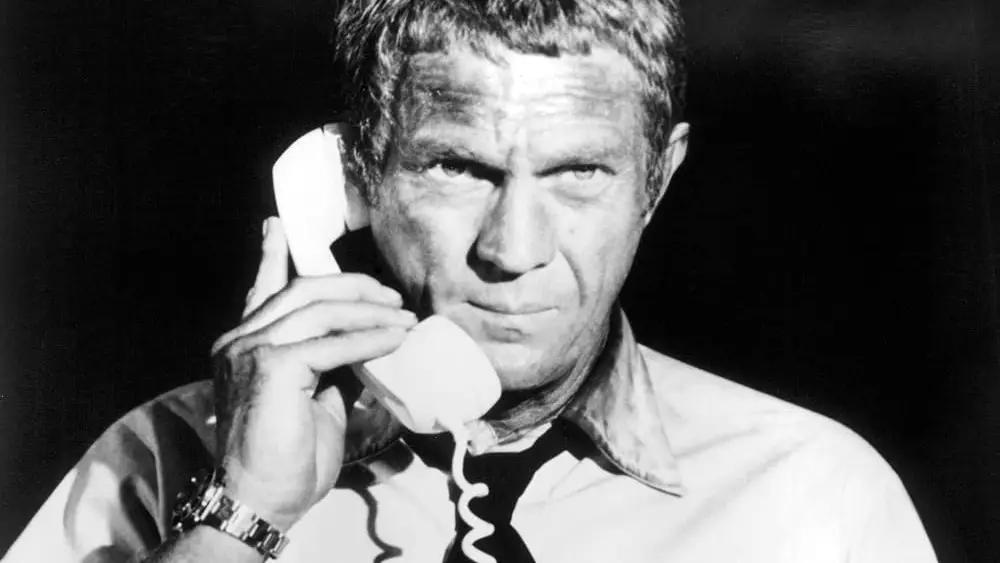
Michael O'Halloran, the fire chief McQueen plays in The Towering Inferno, spends the film fighting a blaze that consumes the world's tallest building, wearing a watch engineered to survive water, not flame, and nobody in the film mentions the mismatch. The production reunited McQueen with Paul Newman for the first time since they lost the shared lead in Butch Cassidy and the Sundance Kid to a billing dispute in 1969; neither actor took top billing here either, credited side by side above an ensemble that also included Fred Astaire, Faye Dunaway, William Holden, and O.J. Simpson, scored by John Williams. By 1974 the Submariner had become close to a signature, the same reference photographed on him at Sebring and on the Le Mans set four years earlier, worn constantly off camera across the decade regardless of what a role called for. Documented examples with McQueen's provenance have sold at auction for upward of $230,000.
Rolex Submariner 5512
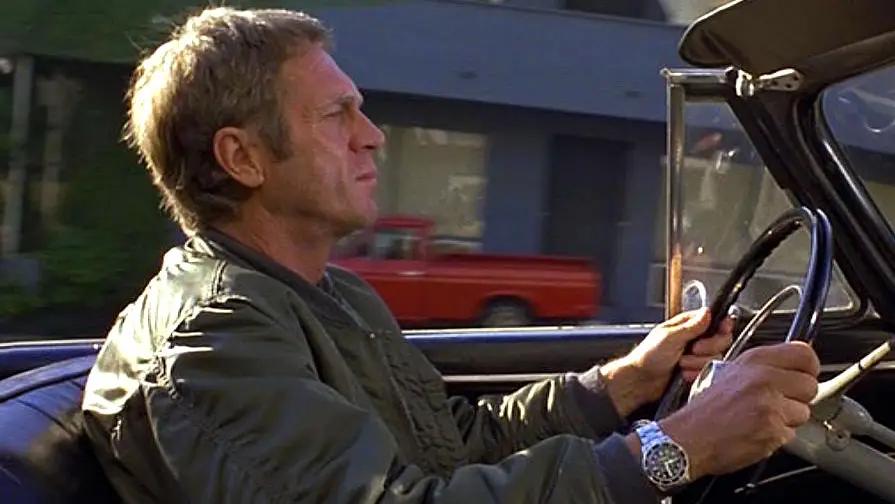
The Hunter was Steve McQueen's last film, and the Submariner on his wrist as bounty hunter Ralph Thorson is the final screen appearance of the watch he'd worn for a decade. He specifically asked stunt coordinator Gary Combs, already assigned to double him, to step aside so his longtime stuntman Loren Janes could take the role instead, the two men having worked together since Wanted Dead or Alive in 1958 and resembling each other closely enough, according to McQueen's first wife Neile Adams, to pass as twins. McQueen finished filming shortly before being diagnosed with pleural mesothelioma, a cancer linked to asbestos exposure with no cure available at the time, and died that November at 50. Every other watch tied to his name arrived through a script, a stylist, or an advertising deal. This one was already on his wrist before the film needed it to be, and it was still there when the film was the last thing he had left to finish.